
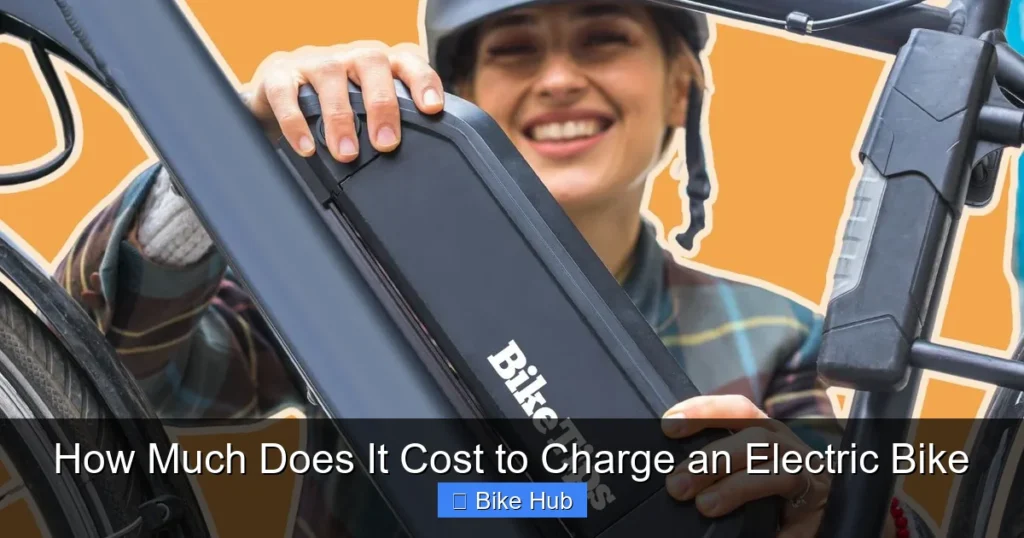
Charging an electric bike is surprisingly affordable, typically costing just a few cents per session. This guide breaks down the exact math behind e-bike charging costs, helping you budget smarter and ride greener.
Key Takeaways
- Battery capacity determines cost: Most e-bike batteries hold 300–700 watt-hours (Wh), directly affecting how much energy they use.
- Electricity rate matters: The national average in the U.S. is about $0.16 per kWh—your local rate changes your total cost.
- Full charge costs pennies: Expect to pay between $0.04 and $0.12 for a full charge, depending on battery size and electricity price.
- Partial charges add up slowly: Topping off your battery regularly uses less energy than full recharges, keeping costs low.
- Charging habits impact longevity: Avoid overcharging and extreme temperatures to preserve battery health and reduce long-term replacement costs.
- Compare to gas savings: Even with rising electricity prices, e-bikes remain far cheaper than cars or motorcycles per mile.
- Use smart charging tools: Timers, off-peak rates, and efficient chargers can further cut costs and protect your battery.
How Much Does It Cost to Charge an Electric Bike?
If you’re new to electric bikes—or just curious about running costs—you might be wondering: How much does it actually cost to charge an e-bike? The short answer? Usually less than the price of a gumball. But let’s dig into the details so you know exactly what you’re paying for—and how to keep those costs as low as possible.
In this guide, we’ll walk you through a simple step-by-step method to calculate your personal e-bike charging cost. You’ll learn how battery capacity, electricity rates, and charging habits all play a role. Plus, we’ll share practical tips to maximize efficiency and extend your battery’s life. Whether you ride daily for commuting or weekend adventures, understanding these costs helps you make smarter, greener choices.
Step 1: Find Your E-Bike Battery Capacity
Visual guide about How Much Does It Cost to Charge an Electric Bike
Image source: discerningcyclist.com
The first step in calculating charging cost is knowing your battery’s energy storage capacity. This is measured in watt-hours (Wh)—a unit that tells you how much electrical energy the battery can hold.
Most consumer e-bikes come with batteries ranging from 300 Wh to 700 Wh. For example:
– A budget-friendly city e-bike might have a 400 Wh battery.
– A high-performance mountain e-bike could pack a 625 Wh or even 750 Wh battery.
You can usually find this info in your owner’s manual, on the battery itself, or in the product specs online. Look for labels like “48V 10.4Ah” — to convert volts (V) and amp-hours (Ah) to watt-hours, multiply them:
Volts × Amp-hours = Watt-hours
So, 48V × 10.4Ah = 499.2 Wh.
💡 Pro tip: If you’re unsure, check your manufacturer’s website or contact customer support. Knowing your exact Wh rating ensures accurate cost calculations.
Step 2: Check Your Local Electricity Rate
Visual guide about How Much Does It Cost to Charge an Electric Bike
Image source: kornorge.com
Next, you need to know how much your utility company charges per kilowatt-hour (kWh). This is the standard unit for household electricity billing.
As of 2024, the average U.S. residential electricity rate is around $0.16 per kWh, but this varies widely by state and provider. For instance:
– Louisiana: ~$0.11/kWh
– California: ~$0.28/kWh
– New York: ~$0.23/kWh
To find your exact rate:
– Check your latest electricity bill (look for “cents per kWh” or “$/kWh”).
– Visit your utility provider’s website.
– Use the U.S. Energy Information Administration (EIA) tool for regional averages.
Why does this matter? Because even small differences add up over hundreds of charges. If you live in a high-rate area, optimizing your charging strategy becomes even more valuable.
Step 3: Calculate the Cost Per Charge
Now for the math—don’t worry, it’s simpler than it looks!
Use this formula:
Cost = (Battery Capacity in Wh ÷ 1,000) × Electricity Rate ($/kWh)
Let’s try an example:
Your e-bike has a 500 Wh battery, and your electricity rate is $0.16/kWh.
Calculation:
(500 ÷ 1,000) = 0.5 kWh
0.5 kWh × $0.16 = $0.08 per full charge
That’s eight cents! Even if you charge every day for a month, you’d spend less than $2.50.
Another example: A 700 Wh battery at $0.20/kWh:
(700 ÷ 1,000) × 0.20 = $0.14 per charge.
💡 Real-world note: Most riders don’t fully drain their batteries before recharging. If you top off from 40% to 100%, you’re only using 60% of the total capacity—so your actual cost per session is even lower.
Step 4: Factor in Charging Efficiency
Batteries and chargers aren’t 100% efficient. Some energy is lost as heat during charging—typically 10% to 20% loss.
To account for this, multiply your calculated cost by 1.1 to 1.2. Using our earlier 500 Wh example:
– Base cost: $0.08
– With 15% loss: $0.08 × 1.15 = $0.092
Still under ten cents! This adjustment ensures your estimate reflects real-world usage.
Step 5: Estimate Monthly and Annual Costs
Once you know your cost per charge, scaling it up is easy.
Say you charge your e-bike every other day (15 times per month):
– $0.09 × 15 = $1.35/month
– $1.35 × 12 = $16.20/year
Compare that to driving a car: the average American spends over $2,000 annually on gas. Even public transit costs more per year than e-bike charging!
For frequent riders (daily charging):
– $0.09 × 30 = $2.70/month
– $32.40/year
Still incredibly economical.
Practical Tips to Reduce Charging Costs
Want to stretch your dollars—and your battery life—even further? Try these smart strategies:
Charge During Off-Peak Hours
Many utilities offer lower rates at night (e.g., 9 PM–6 AM). Set a timer or use a smart plug to charge automatically during these windows. This can cut your effective rate by 30–50% in some areas.
Avoid Overcharging
Modern e-bike chargers usually stop when full, but leaving the battery plugged in for days can stress it. Unplug once charged, or use a charger with auto-shutoff. This also prevents unnecessary energy waste.
Store and Charge in Moderate Temperatures
Extreme cold or heat reduces charging efficiency and damages lithium-ion cells. Charge indoors at room temperature (60–75°F / 15–24°C) whenever possible. Need storage advice? Learn how to store a recumbent bike properly—many principles apply to e-bikes too.
Use the Right Charger
Always use the manufacturer-recommended charger. Third-party or mismatched chargers may charge inefficiently or harm your battery. If you’re using accessories like lights or cameras, check out how to charge a bike light safely—similar care applies.
Monitor Battery Health
A degraded battery holds less charge and may require more frequent top-ups. Keep an eye on range per charge. If you notice a significant drop, it might be time for maintenance or replacement.
Troubleshooting Common Charging Issues
Sometimes, charging doesn’t go as planned. Here’s how to handle common problems:
Battery Won’t Hold a Charge
– Ensure the battery is fully seated in the bike or charger.
– Try a different outlet or charger cable.
– If the issue persists, the battery may be nearing end-of-life (typically after 500–1,000 charge cycles).
Charger Gets Very Hot
Some warmth is normal, but excessive heat is a red flag. Stop using the charger immediately and contact the manufacturer. Never charge near flammable materials.
Slow Charging Speed
This could mean a faulty charger, low-voltage outlet, or cold battery. Warm the battery to room temperature before charging, and test with another charger if possible.
Inconsistent Range
If your e-bike’s range varies wildly, check tire pressure—underinflated tires increase resistance and drain the battery faster. For guidance, see how to check bike tire pressure the right way.
Conclusion
Charging an electric bike is one of the most cost-effective ways to get around. With a typical full charge costing less than a dime, e-bikes offer incredible value compared to cars, motorcycles, or even public transit. By understanding your battery capacity, local electricity rates, and charging habits, you can accurately estimate—and minimize—your energy expenses.
More importantly, smart charging practices not only save money but also extend your battery’s lifespan, ensuring your e-bike stays reliable for years. So plug in with confidence: you’re making a green choice that’s gentle on both the planet and your wallet.
Ready to go further? Explore our guide on how to prepare a mountain bike for long rides to maximize your e-bike’s performance on extended adventures.



