
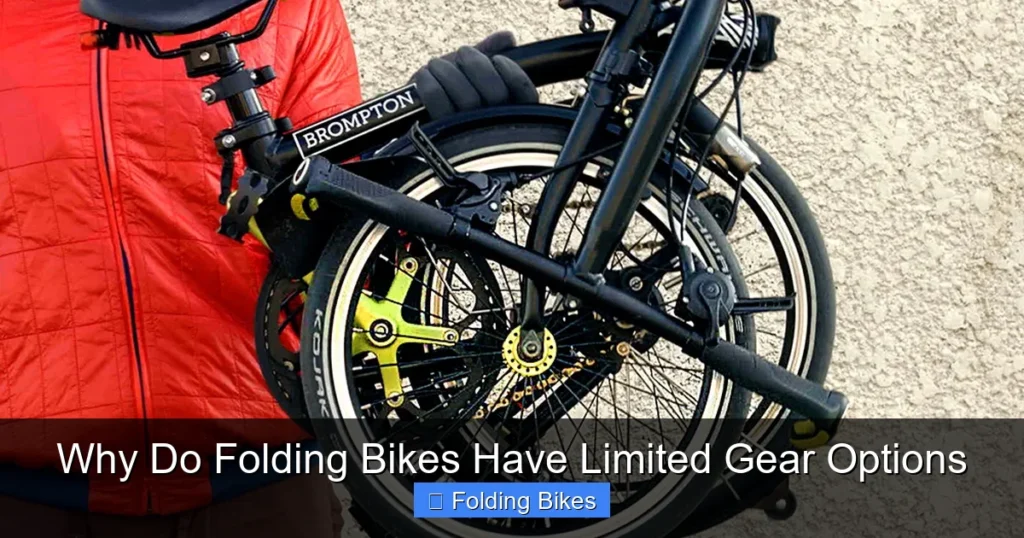
Folding bikes often have fewer gears due to compact frames, space-saving components, and weight limits. This guide explains the engineering trade-offs behind limited gearing and offers practical tips for choosing the right model.
Key Takeaways
- Space constraints limit drivetrain complexity: Folding bikes prioritize compactness, leaving little room for large gear systems.
- Weight reduction affects component choices: Lighter materials and smaller parts often mean fewer gears to maintain portability.
- Internal gear hubs save space but offer fewer ratios: Many folding bikes use internal hubs with 3–8 speeds instead of external derailleurs.
- Smaller wheels impact gearing efficiency: 16″ or 20″ wheels require different gear ratios, influencing overall range.
- Urban commuting reduces need for high gear counts: Most folding bikes are designed for city riding, where extreme gearing isn’t necessary.
- Maintenance simplicity favors fewer gears: Simpler drivetrains mean less upkeep—ideal for casual riders.
- Upgrades are possible but limited by frame design: Some models allow gear additions, but structural limits apply.
Why Do Folding Bikes Have Limited Gear Options?
If you’ve ever shopped for a folding bike, you may have noticed something: compared to full-sized road or mountain bikes, most folding models come with surprisingly few gears. While a standard mountain bike might boast 18 to 27 speeds, many folding bikes top out at 3, 7, or 8. So why is that?
This guide will walk you through the key reasons behind limited gear options on folding bikes—covering design constraints, engineering trade-offs, and real-world usability. You’ll learn how space, weight, wheel size, and intended use all play a role in shaping a folding bike’s drivetrain. By the end, you’ll understand not only why these bikes have fewer gears, but also whether that’s actually a problem—and how to pick the right model for your needs.
Understanding the Core Design Challenge: Space vs. Functionality
At the heart of every folding bike is a simple goal: make it compact enough to carry, store, or take on public transit—without sacrificing too much ride quality. Achieving that balance means making tough choices about what components to include.
1. Frame Folding Mechanisms Take Up Critical Real Estate
Folding bikes use hinges, latches, and collapsible frames to shrink down. These mechanisms require strong, reinforced joints that often sit where traditional gear systems—like rear derailleurs—would normally go. For example, the rear triangle of the frame (where the derailleur hangs) might be split or shortened to allow folding, leaving no room for a full-sized cassette or multiple chainrings.
As a result, manufacturers often opt for simpler drivetrains that don’t need extra space. A single front chainring with a 3-speed internal hub, for instance, can fit neatly within a compact rear triangle—something a 3×9 external setup simply can’t do.
2. Weight Savings Are a Top Priority
Every gram counts on a folding bike. Heavier bikes are harder to carry up stairs, onto trains, or into apartments. To keep weight down, manufacturers avoid bulky components like multiple chainrings, long derailleur cages, and wide-range cassettes.
Instead, they lean on lightweight alternatives such as:
– Single-speed drivetrains (common on budget models)
– 3- or 5-speed internal gear hubs (like Shimano Nexus or Sturmey-Archer)
– Compact external derailleurs with limited gear ranges
These choices reduce weight but also limit gear variety. It’s a trade-off: portability over performance.
The Role of Wheel Size in Gearing Limitations
Most folding bikes use smaller wheels—typically 16″, 20″, or occasionally 24″. While these wheels enhance portability, they also affect how gears work.
Smaller Wheels = Higher Cadence, Lower Torque
Smaller wheels cover less ground per pedal revolution. That means you need to spin the pedals faster to maintain speed. To compensate, folding bikes often use lower gear ratios (easier pedaling) to help riders climb hills without excessive effort.
But here’s the catch: because the wheels are small, adding very high gears (for fast flat-road riding) can make the bike feel “over-geared.” You’d spin out quickly, meaning you’d reach maximum speed with minimal pedal input—making high gears impractical.
As a result, many folding bikes are optimized for moderate speeds (15–20 mph), which suits city commuting just fine. This reduces the need for a wide gear range.
Internal Hubs Fit Better with Small Wheels
Internal gear hubs (IGH) are a popular choice for folding bikes because they’re enclosed, low-maintenance, and fit well within compact rear wheels. However, most IGH systems offer fewer speeds than external derailleur setups.
For example:
– A Shimano Nexus 3-speed hub gives you low, middle, and high—perfect for flat cities with mild hills.
– A Sturmey-Archer 5-speed offers a bit more range but still falls short of a 10- or 11-speed road bike.
While some high-end folding bikes now feature 8- or 11-speed internal hubs (like the Rohloff Speedhub), these are expensive and add weight—defeating some of the bike’s portability advantages.
Urban Use Case: Do You Really Need More Gears?
Let’s be honest: most folding bikes are built for city life—not mountain trails or long-distance touring. If your ride consists of short commutes, errands, or train connections, you likely don’t need 20+ gears.
City Riding = Predictable Terrain
Urban environments are generally flat or gently rolling. Traffic lights, stop signs, and congestion mean you’re frequently starting and stopping—not maintaining high speeds. In this context, a 3- to 8-speed bike is more than sufficient.
In fact, fewer gears can be a benefit:
– Less shifting = smoother, more predictable riding
– Simpler maintenance = fewer breakdowns
– Lower cost = better value for casual riders
For example, the popular Brompton folding bike comes standard with a 3-speed internal hub—ideal for London’s streets. Riders who need more range can upgrade to a 6-speed, but most find the base model perfectly adequate.
Electric Folding Bikes Change the Game
Interestingly, the rise of e-folding bikes is shifting expectations. With motor assistance, riders don’t need as many gears to tackle hills or headwinds. A 3-speed electric folding bike can outperform a 10-speed manual one on steep inclines—thanks to the motor doing the heavy lifting.
This trend may lead to even simpler gearing in the future, as motors reduce reliance on mechanical gear ranges.
Can You Upgrade Gears on a Folding Bike?
You might be wondering: if my folding bike has limited gears, can I add more?
The short answer: sometimes—but with caveats.
Frame and Hub Compatibility Matter Most
Upgrading gears depends heavily on your bike’s design. If it uses an internal hub, you’re usually stuck with that system unless you replace the entire rear wheel. Swapping to a derailleur-based system often isn’t feasible due to:
– Lack of derailleur hanger
– Insufficient chainstay length
– Frame clearance issues
Some models, like the Tern Link series, are designed with upgrade paths in mind. They may support both internal hubs and external derailleurs, giving you flexibility.
Consider Your Needs Before Upgrading
Before spending money on upgrades, ask yourself:
– Do I really need more gears, or am I just used to having them?
– Will the added weight and complexity hurt portability?
– Is my current bike holding me back on hills or long rides?
If you’re planning serious bikepacking trips, you might be better off choosing a folding bike built for adventure—like those in our guide to the best folding mountain bikes for bikepacking—which often feature wider gear ranges and more robust frames.
Troubleshooting Common Gearing Issues
Even with limited gears, folding bikes can face drivetrain problems. Here’s how to handle the most common ones:
Problem: Chain Skips or Slips
Cause: Worn chain or sprocket, misaligned derailleur (if applicable), or loose tension.
Visual guide about Why Do Folding Bikes Have Limited Gear Options
Image source: bicycleshome.com
Solution: Check chain wear with a ruler or tool. Replace if stretched. For internal hubs, ensure proper cable tension and lubrication.
Problem: Difficulty Shifting
Cause: Dirty cables, stiff linkages, or incorrect adjustment.
Solution: Clean and lubricate shift cables. For internal hubs, consult the manufacturer’s service guide—some require specific procedures.
Problem: Limited Hill-Climbing Ability
Cause: Gear range too high for your terrain.
Solution: Consider a model with a lower gear ratio or switch to an e-folding bike. Alternatively, improve your pedaling technique—standing climbs and momentum help.
Choosing the Right Folding Bike for Your Needs
Not all folding bikes are created equal. When gear count matters, here’s what to look for:
1. Match Gears to Your Terrain
- Flat cities: 3-speed internal hub is plenty.
- Hilly areas: Look for 7–8 speeds or a wide-range internal hub.
- Long-distance or loaded touring: Consider models with external derailleurs or high-end IGHs.
2. Prioritize Reliability Over Gear Count
A bike with fewer, well-maintained gears will outperform a high-gear-count model that’s constantly breaking down. Internal hubs, while limited, are sealed and require minimal upkeep—ideal for daily commuters.
3. Test Ride Before Buying
Always test ride a folding bike on terrain similar to your daily route. Pay attention to how it feels on hills and at speed. If you’re struggling in the lowest gear, you may need more range.
For inspiration, check out our roundup of best high-gear mountain bikes—while not folding, these show what’s possible with full-sized frames and why compact designs must compromise.
Conclusion: Fewer Gears Aren’t Always a Bad Thing
So, why do folding bikes have limited gear options? It all comes down to design priorities: portability, weight, simplicity, and urban usability. While they may lack the gear range of full-sized bikes, folding bikes are engineered for a different purpose—and for most riders, that’s perfectly fine.
Rather than seeing limited gears as a flaw, view them as a smart compromise. They make folding bikes easier to carry, simpler to maintain, and ideal for everyday city life. And with advancements in internal hubs and electric assist, the gap is narrowing.
When choosing a folding bike, focus less on the number of gears and more on how well it fits your lifestyle. Whether you’re commuting, traveling, or just need a bike that fits in your apartment, the right folding bike will get you there—smoothly, efficiently, and without the bulk.
For maintenance tips, don’t miss our guide on the best folding bike pump—because even the simplest bike needs reliable tires.



